How the Marrakech souks actually work
The first thing to understand about shopping in Marrakech is that the souks are not a collection of independent shopping streets designed for tourists. They are a historic network of specialist markets inside the medina, traditionally organised around different crafts and trades.
The easiest place to begin is near Jemaa el-Fna. From there, Souk Semmarine forms one of the main arteries through the market, with smaller specialist souks branching away from it. The further you move from the main tourist flow, the more specialised the shops tend to become.
That distinction matters. If you want a general souvenir, Semmarine is convenient. If you want a handmade leather bag, brass lantern, traditional rug or naturally dyed textile, it is worth leaving the main route and finding the quarter where that craft is actually made and sold.
Main artery · All-round shopping
Souk Semmarine
The main covered shopping route through the medina. Start here to understand the layout, then branch into the smaller specialist souks.
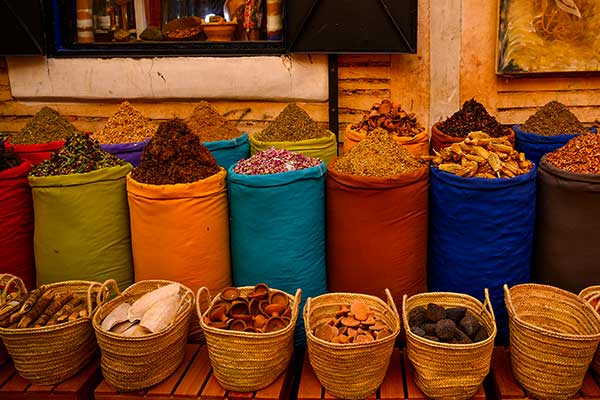
Specialist market · Spices
Rahba Kedima
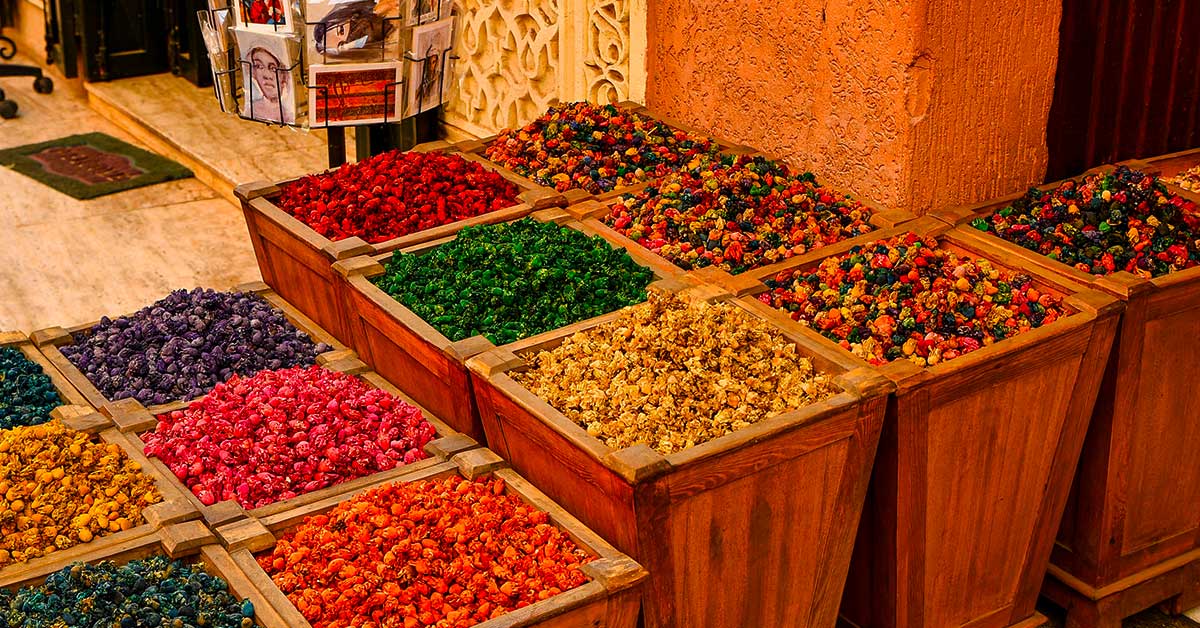
A colourful open square surrounded by spice, herbal and traditional-product stalls. One of the most atmospheric stops away from the main drag.
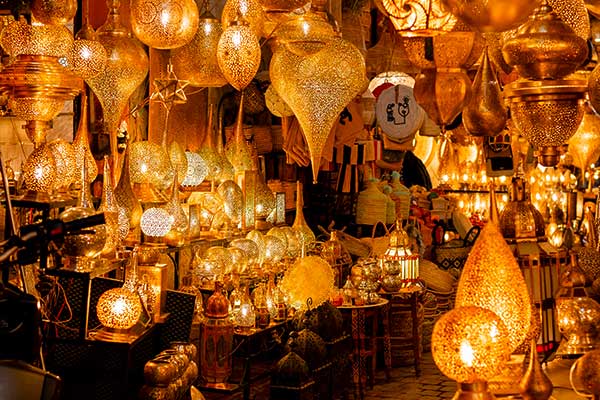
Specialist market · Metalwork
Souk Haddadine
The metalworkers' quarter, where the sound of hammering leads you towards lanterns, decorative metalwork and traditional craftsmanship.
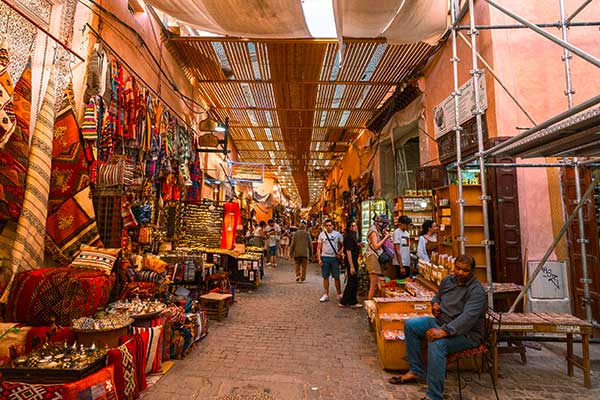
Specialist market · Leather
Souk Cherratine
A better destination than the main tourist streets if leather is what you actually came to buy: bags, belts, wallets and babouche slippers.
Souk Semmarine — the main artery of Marrakech
Souk Semmarine is the obvious starting point for a first visit. It runs through the heart of the medina and is one of the busiest and most tourist-facing parts of the souk network.
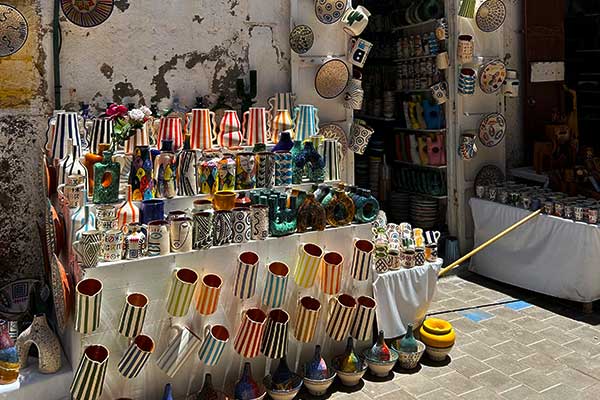
You will find an enormous range of products here: textiles, kaftans, scarves, ceramics, leather goods, decorative objects, jewellery and souvenirs. It is colourful, covered and visually spectacular, but it is also where you are most likely to encounter persistent sales pitches and tourist-oriented pricing.
That does not mean you should skip it. Quite the opposite. Walk through Semmarine first, get your bearings, look at the quality and prices, and then start exploring the side streets.
The First Price Is Not the Final Price
In many Marrakech souks, the first price quoted is an opening point rather than a fixed retail price. Don't feel pressured to buy immediately. Look at several similar products, decide what the item is worth to you, and negotiate calmly.
What should you buy on Souk Semmarine?
Semmarine is particularly useful for browsing textiles, kaftans, scarves, ceramics, leather goods and decorative pieces. It is also a good place to compare products before venturing into the specialist souks.
If you see something you love, take a mental note rather than automatically buying it from the first shop. You may find a similar item deeper inside the medina, sometimes with more room to negotiate.
Rahba Kedima — spices, herbs and colour
Rahba Kedima is one of the most atmospheric places in the Marrakech medina. Traditionally associated with spices, herbs and apothecary-style products, the square and its surrounding shops are packed with colour.
Expect cones of spices, dried flowers, herbs, baskets and traditional Moroccan products. Even if you do not plan to buy anything, this is a good place to slow down and look around.
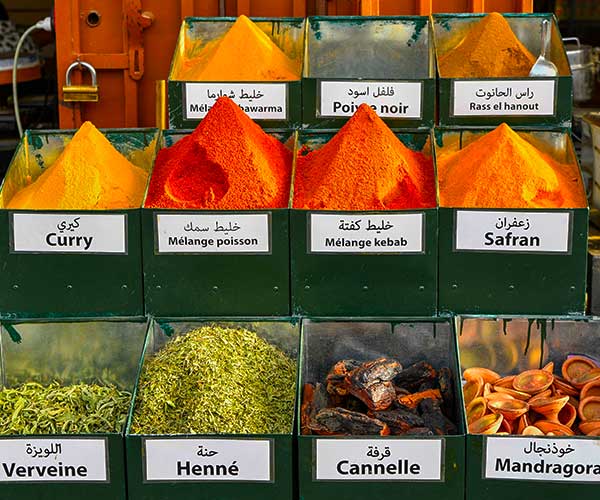
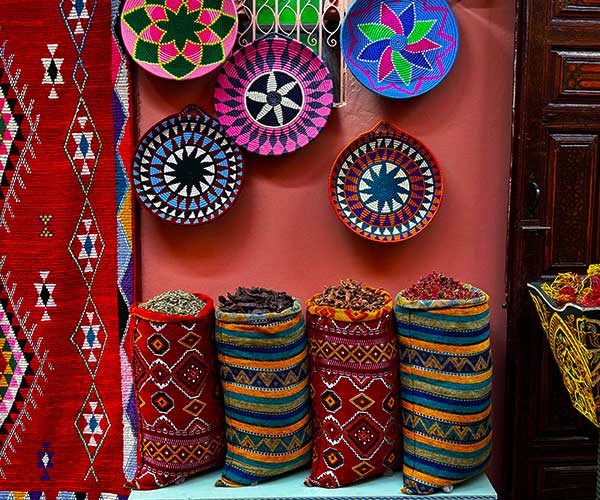
Rahba Kedima is as much about the atmosphere and colour of the medina as it is about shopping.
What to look for
Spices, dried herbs, rose products and traditional pantry ingredients can make practical souvenirs, particularly if you enjoy cooking. Ask what an ingredient is, where it comes from and how it is normally used before buying.
Be particularly careful with products presented as miracle cosmetics or medicinal cures. If something is being sold as a treatment for a health condition, treat the claim as a sales pitch rather than medical advice.
Souk Haddadine — metalworkers and lanterns
Souk Haddadine is the place to visit when you want to see Marrakech's metalworking tradition. The atmosphere changes as soon as you enter: instead of fabrics and soft goods, you hear the sound of metal being shaped and hammered.
Lanterns are the obvious purchase, but you will also find decorative metalwork, trays, mirrors, door hardware and other objects inspired by Moroccan architectural details.
Shopping Tip
If you are buying a large lantern or decorative piece, check how it is constructed before negotiating. Weight, metal thickness, finish, wiring and whether the piece is actually handmade can make a significant difference to the price.
Can you have something made?
In some workshops, artisans can adapt or produce pieces to order. If you have a specific size, colour or design in mind, show a photograph and ask what is possible before discussing the final price and delivery time.
Souk Cherratine — leather and babouche slippers
If you want Moroccan leather goods, Souk Cherratine is one of the specialist areas worth seeking out. The quarter is associated with leatherworkers and shops selling bags, belts, wallets, poufs and the famous pointed babouche slippers.
Marrakech has a long leatherworking tradition, and the difference between a cheap souvenir and a well-made piece can be significant. Look closely at stitching, edges, lining, hardware and the smell and feel of the leather.
Leather Shopping Checklist
- Check the stitching Look for straight, consistent seams
- Check the edges They should be finished rather than roughly cut
- Check the lining Especially on bags and larger pieces
- Check the hardware Zips, buckles and clasps should feel solid
- Compare several shops Quality and prices vary considerably
- Ask about the leather Know exactly what material you are buying
Souk des Teinturiers — the Dyers' Souk
Souk des Teinturiers, or the Dyers' Souk, is one of the most photogenic corners of the medina. Coloured skeins of wool and textiles hang above the narrow lanes, creating a canopy of reds, yellows, blues and other saturated colours.
The visual appeal is almost as important as the shopping. This is a place to observe the craft process and understand how different parts of Marrakech's traditional textile economy connect.
You may find textiles and related products for sale, but don't expect every workshop to operate like a conventional souvenir shop. Some artisans are working primarily for other craftspeople and local production.
Best for photography
Go during daylight when the colours are strongest. Be respectful when photographing artisans and workshops, particularly if someone is actively working. Ask before taking close-up portraits.
Souk el Attarine — brass, copper and traditional goods
Souk el Attarine is associated with brass and copper goods, as well as aromatic and traditional products. It is another example of how the Marrakech souks are divided by craft rather than being one enormous undifferentiated market.
Trays, decorative objects, tea accessories and metalwork can make beautiful souvenirs, particularly if you want something that feels connected to Moroccan interiors rather than a generic tourist product.
Look carefully at the finish. Some pieces are highly polished and decorative, while others have a more handmade, irregular appearance. Neither is automatically better — it depends on what you want.
Carpets, rugs and the Berber market
Moroccan carpets are among the most tempting purchases in Marrakech, and also among the easiest items to buy impulsively.
A genuine handmade rug can vary enormously in price depending on size, materials, age, technique, complexity and provenance. Two rugs that look similar from a distance can require completely different amounts of work.
If you are seriously considering buying a carpet, don't rush. Visit several sellers, ask about the origin and technique, inspect the reverse side, and compare the density and quality of the weaving.
Be Careful With "Antique" Claims
A seller describing a rug as antique does not automatically make it one. If age, provenance or authenticity matters to you, ask for documentation and buy from an established specialist rather than relying solely on a sales story.
The rule for buying a carpet
Never buy a large rug simply because you feel pressured to make a decision. If you love it, understand the price, know how you will transport it home and are genuinely happy with the purchase, then it may be worth it. If you are unsure, walk away and think about it.
What to buy in the Marrakech souks
The best souvenir is not necessarily the most traditionally Moroccan object in the shop. It is the thing you will actually use, display or enjoy once you are home.
Leather
Bags · Belts · Babouches
Leather bags, belts, wallets and babouche slippers are among the classic Marrakech purchases. Focus on construction and material rather than the first price.
Best for: useful souvenirs and everyday pieces
Lanterns
Metalwork · Interiors
Moroccan lanterns can be beautiful statement pieces. Check the construction and remember that large pieces may be complicated to transport.
Best for: home décor and larger souvenirs
Spices
Cooking · Small gifts
Spices, dried herbs and culinary ingredients are affordable, easy to pack and useful once you are home. Ask about ingredients and storage.
Best for: food lovers and small gifts
Best Marrakech souks by product
| Souk / Area | Best for | Atmosphere | Best for first visit? | Shopping tip |
|---|---|---|---|---|
| Souk Semmarine | Textiles, souvenirs, general shopping | Busy · colourful · tourist-facing | Yes | Use it to compare before going deeper |
| Rahba Kedima | Spices, herbs, traditional products | Colourful · atmospheric | Yes | Ask what products actually contain |
| Souk Haddadine | Lanterns, metalwork | Noisy · artisan-focused | Yes | Check weight and construction |
| Souk Cherratine | Leather, bags, babouches | Specialist · workshop-focused | Yes | Inspect stitching and material |
| Souk des Teinturiers | Dyed textiles, photography | Colourful · traditional | Yes | Visit in daylight |
| Souk el Attarine | Brass, copper, traditional goods | Specialist · historic | Yes | Compare finishes and craftsmanship |
| Carpet Souks | Moroccan rugs and carpets | Sales-focused · specialist | If buying a rug | Never rush a major purchase |
How to bargain in the Marrakech souks
Bargaining is part of shopping culture in many Marrakech souks. It can feel uncomfortable if you come from a country where prices are normally fixed, but it becomes much easier when you stop treating it as a confrontation.
The goal is not necessarily to get the absolute lowest price. The goal is to reach a price that both sides are comfortable with.
1. Don't reveal your maximum budget
If you immediately tell a seller how much you are willing to spend, you have given away the most useful information in the negotiation. Ask the price first and take your time.
2. Compare before buying
This is particularly important for leather, carpets and decorative objects. Seeing several versions of the same type of product gives you a much better understanding of quality and price.
3. Make a reasonable counteroffer
You do not need to insult the seller by offering an absurdly low amount. A calm counteroffer is enough. If the price remains too high, thank the seller and walk away.
4. Be prepared to leave
Walking away is one of the most useful parts of bargaining because it removes the pressure to decide immediately. Sometimes the seller will make a final offer; sometimes they won't. Either outcome is fine.
5. Know when not to haggle
Not every transaction needs a negotiation. Some shops operate with fixed prices, and small food purchases or inexpensive everyday products are not worth turning into a lengthy bargaining session.
The Most Important Rule
If you don't actually want the item, don't start negotiating just for fun. Once you have spent ten minutes discussing a price, the seller may reasonably expect you to buy if an agreement is reached.
Practical information before visiting the Marrakech souks
What time should you visit?
Morning is generally the easiest time to explore. Temperatures are more comfortable, the light can be beautiful and the busiest tourist flow has not yet reached its peak.
Late afternoon can also be atmospheric, particularly as the medina becomes busier and Marrakech transitions towards evening. If you dislike crowds, however, don't leave your main shopping until the busiest part of the day.
How much time do you need?
Give yourself at least three hours for a first visit. Half a day is better if you want to explore specialist souks, stop for tea and actually browse rather than rushing through.
Serious shoppers could easily spend an entire day inside the medina.
How do you avoid getting lost?
Accept that you probably will get slightly lost. The souks are a network of narrow lanes rather than a straightforward grid.
Keep a few major landmarks in mind, especially Jemaa el-Fna, the Ben Youssef area and the main Souk Semmarine route. Offline maps can also be useful, although the dense buildings and narrow lanes can make GPS less precise.
Should you hire a guide?
You don't have to. Exploring independently can be one of the most memorable parts of Marrakech.
A licensed guide can nevertheless be valuable if this is your first visit, particularly if you want to understand traditional crafts, locate particular workshops or shop for a valuable item such as a carpet.
What should you carry?
Keep your bag small and secure. The lanes can be extremely crowded, and carts, bicycles and scooters move through spaces that look far too narrow for them.
Carry some Moroccan dirhams in smaller denominations, but avoid carrying large amounts of cash while browsing. Comfortable shoes are essential because you will probably walk much more than expected.
The best thing you can buy in the Marrakech souks is not necessarily the most expensive object. Sometimes it is simply the memory of getting beautifully lost in a city that still makes craft feel alive. Travel notes, 2026
Frequently Asked Questions About the Marrakech Souks
What are the best souks in Marrakech?
The best souks depend on what you want to see or buy. Semmarine is the main shopping artery, Cherratine is known for leather, the Dyers' Souk for colourful textiles, Haddadine for metalwork, Rahba Kedima for spices and traditional products, and Attarine for brass and copper goods.
What should I buy in the Marrakech souks?
Popular purchases include Moroccan rugs, leather bags, babouche slippers, lanterns, brass and copper objects, ceramics, spices, textiles, jewellery and traditional decorative pieces.
Do you have to haggle in Marrakech?
Haggling is expected in many souks, particularly for handmade goods and decorative products. Negotiate calmly, compare prices and remember that fixed-price shops also exist.
Are the Marrakech souks safe?
The main souks are heavily visited, but they are busy and easy to become disoriented in. Keep valuables secure, watch for traffic in narrow lanes and be cautious with unsolicited offers to take you somewhere.
Do I need a guide for the Marrakech souks?
No. You can explore independently. A licensed guide can nevertheless make the experience easier if you want to understand the crafts, navigate efficiently or shop for something valuable.